Showing posts with label illustrators. Show all posts

Thursday, April 28, 2011

Julian Hector: Monday is One Day

Scholastic, 2011
Julian Hector dreams in 32-page spreads. And vibrant primary colors. And tight narrative arcs. I'm certain of it. He didn't tell me this outright, but his enthusiasm for the medium is so contagious that he's got me doing it.

Everything about picture books appeals to Julian Hector. Writing and illustrating utilize all the things that he loves to do as a creative person: creating settings and costumes, exploring family and a sense of wonder about the world, conjuring anthropomorphic bugs, and of course, telling stories.

His latest book is a lovely collaboration with author/editor Arthur A. Levine. Monday is One Day (Scholastic, 2011) which, in touching rhyme, celebrates the special relationship between working parents and their children. Julian has graciously stopped by to share his work and enthusiasm with us.


AB: Congratulations on the publication of Monday is One Day! I love that the illustrations show many iterations of families. That pleases me to no end. Could you talk about how you decided upon your illustration content?

JH: Hey Amy, thank you for having me on your wonderful blog! The decision to have a diverse group of families was made when Monday’s third editor came on board the project. After reviewing my first dummy, which felt very dry in its depiction of only a father and son, she consulted with Arthur, and we all agreed that the book should be universally appealing. We wanted children with working parents of any arrangement to find themselves in Monday is One Day. For me, the book sprung to life when this decision was made.

AB: Could you talk about your process for creating the illustrations for Monday is One Day?What medium/ media do you use? About stylistic choices?

The paintings in Monday consist of watercolors and charcoal over a block of Arches hot pressed watercolor paper. I start by doing a graphite transfer of the sketch onto the paper, which leaves a very light outline, then I fill the shapes in with color. For this book,I wanted the colors to be as bright and saturated as possible, so I used several layers of paint, and ample white space to help the colors pop even further. When the paintings were complete, I went over with charcoal, outlining and shading everything. Stylistically, I wanted the book to be as friendly as possible, and the illustrations of H. A.Rey where my principle reference. Not that I actively researched his books; they’re all ingrained in my head. The limited palette of primary colors was crucial for this book: most picture books have a main character that you can follow across the narrative, but with Monday, each of the six main spreads features a different group of characters. It was important that color be used to maintain consistency across the pages. This is how I consider color when illustrating: it’s just another tool to help make the book work.

AB: How did you and Arthur become paired up on this project?
Disney-Hyperion, 2008

JH: I was contacted by Arthur’s editor at Scholastic, after Arthur viewed and liked the F&G of my first book, The Little Matador (Disney-Hyperion, 2008), at ALA in early 2008. I received the email while temping at American Banker during the Bear Stearns collapse. I was probably the only happy person in the financial district that day.

AB: I suspect you're right about that! Who are some of the editors/ art directors you’ve worked with?

I just finished a fourth book with my editor Namrata Tripathi at Atheneum. She and I started working together when I was a student at Parsons, and she was an editor at Disney-Hyperion. For Monday is One Day, the project had three total editors, but I was only on board for two of them: Kara LaReau and Andrea Davis Pinkney. They were both absolutely wonderful. The art directors that I’ve worked with are Ellice Lee (The Little Matador - Disney-Hyperion), Roberta Prussel (This is the Firefighter by Laura Godwin- Disney-Hyperion, 2009), Elizabeth Parisi (Monday is One Day - Scholastic), Ann Bobco (The Gentleman Bug, C.R. Mudgeon 2012 - Atheneum), and Martha Rago (Happily Ever After 2013 - Harper Collins).


AB: What sorts of things inspired you to write and illustrate? Did you always want to do both? Did you want to do this when you were a kid? If not, what did you wish you’d be doing?

JH: I’ve been writing and illustrating since I was very young. I had a lonely childhood, and created characters and narratives as a way of keeping myself entertained. I really am a product of my environment. I don’t feel that I have any natural talent. I definitely wanted to do other things growing up. I wanted to be an inventor, a paleontologist, a marine mammal biologist, and I entered Parsons wanting to be an architect, but quickly realized that my career should involve the set of skills that I acquired in order to survive my childhood.

AB: Do you stay in touch with any of the teachers or students from your time at Parsons? How have they (either teachers and/or students) helped teach you how to write and illustrate for kids? What were the major lessons that you took away from your time at Parsons?

JH: I keep in touch with two of my former professors; Pat Cummings, and Sergio Ruzzier. Pat teaches the Parsons Children’s Book making class, which I took my senior year of college, and where my first book, The Little Matador, was a class project. Pat acted as a mentor much earlier, though, when I expressed an interest in picture books during my first year in the illustration Department. She took me under her wing, taught me about the 32 page format, shared her publishing contacts with me, and cheered me on all the way to publication. I owe so much to Pat. My wish to become an author/illustrator materialized very quickly after meeting her.

Disney-Hyperion, 2009
AB: Can you give us a run down of the books you've worked on? Can you tell us a bit about you path to publication?
 
JH: Sure thing. During my junior year of college, I finally had a completed picture book dummy and portfolio. My mentor, Pat Cummings, approved of both, and gave me a list of editor contacts, while helping me polish my query letter with an important emphasis on getting a face-to-face meeting.

Initially, only Namrata Tripathi, of Disney-Hyperion replied and agreed to meet with me. Nami (Namrata’s nickname) was the warmest person and we got along immediately. She liked my work, and saw potential in my dummy (it was eventually turned down at acquisitions), but most importantly, Nami saw an image in my portfolio of a matador giving a bull a flower, and made it clear that she would love for me to give the scene a
story. When my senior year rolled around I did just that, and wrote The Little Matador, which, after a revision or two, was bought by Nami in a two book deal.

After finishing the Illustrations for The Little Matador in 2007, Nami had me Illustrate This is the Firefighter (Laura Godwin), while I wrote The Gentleman Bug. Then I was contacted by Scholastic, and Harper Collins, regarding Monday is One Day and Happily Ever After (a bilingual fairy tale anthology), respectively. I finished The Gentleman Bug, followed by Monday is One Day, then Nami offered me C.R. Mudgeon (Leslie Muir - 2012), which I completed last month. Currently, I’m finishing the Illustrations for Happily Ever After, which is due later in the fall.
Atheneum, 2010

AB: What did you read as a kid?

JH:  Dinotopia, Are You My Mother, No Fighting No Biting, Corduroy, In the Night Kitchen, Lyle, Lyle, Crocodile, Babar, Stellaluna, Trouble for Trumpets, David Macaulay’s books - City, Cathedral, Castle, The Way Things Work, The Little Engine that Could, Jeremy Thatcher Dragon Hatcher, The Far Side comics, Charles Addams’ New Yorker cartoons, Edward Gorey’s various anthologies, and The Story of Ferdinand. There are only a few exceptions where I branched out and read a picture-less book.


AB: Which artists have influenced you? What did you like looking at as a child? What impressed you?

JH: Trouble for Trumpets was probably the most impressive book that I experienced as a  child. I found it to be completely immersive, and I had it in constant check-out from the school library. It informs a lot of what I do as an illustrator, too. I owe my desire to have a map in all of my books to Trouble for Trumpets. Dinotopia was another book that I couldn’t get enough of. Both Trouble for Trumpets and Dinotopia feature thorough world-building, and that’s an element that I try to bring into my work. I usually don’t begin to write a story until I have a fully realized sandbox that I can play in.
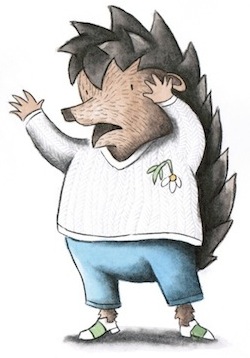

C.R. Mudgeon by Leslie Muir, Atheneum, 2012
AB: What current authors and illustrators do you enjoy these days?

JH: Shaun Tan, Peter Brown, Sergio Ruzzier, Stephen Savage, David Ezra Stein, Suzy Lee, Renata Liwska, Jen Corace, Carson Ellis, and more Shaun Tan.

AB: If you could go back and talk to yourself when you were beginning illustrator/ writer, what advice would you offer?

JH: I would have told myself to mind the deadlines!!! Not only is it healthy to meet your deadlines in the professional sense, it’s creatively healthy, too. Sidelining your sense of perfectionism to complete a book on time and get it out to the world, then move on to your next idea, is a wonderful cycle to maintain. I put far too much weight on making ‘perfect’ illustrations when I began. I think that I repainted the first scene in The Little Matador close to 20 times - bad!

AB: What is your best tip for book promotion? How do you balance your creative life as a writer-artist with the responsibilities (speaking, promotion, contracts, etc.) of being an author-illustrator?

Julian Hector
JH: I’m a novice when it comes to promotion. I mean, I’ve done a few book signings, school visits, spoke at an SCBWI event, and I love all manner of social media, but I’m just now at the point where illustrating isn’t an all consuming endeavor and I have leftover energy to think about a book’s additional activities. Also, I’m a terrible multitasker, and have a hard time switching gears. Peeling myself away from the studio is difficult, but peel away I must - it really is crucial to get out and connect with people, and there’s an endless array of conferences, conventions, and book fairs to take advantage
of.

AB: Monday is One Day hit the shelves on April 1st. Will you be doing any signings that I could mention?

JH: I don’t have any signings planned, but Arthur will be speaking and signing this weekend in the Twin Cities.

AB: Minnesotans- don’t miss out! Here’s Arthur's book trailer to get you excited, followed by info on Arthur's two book signings and one conference keynote:


Friday, April 29th at 6:30pm
Wild Rumpus
2720 W 43rd St
Minneapolis, MN 55410
612-920-5005


 Saturday, April 30, 1011 a.m.
Children’s and Young Adult Literature Conference
Welcome and Keynote Address with Arthur A. Levine

Sunday, May 1st at 2pm
The Red Balloon Bookshop
891 Grand Avenue
St. Paul, MN 55105
651-224-8320

Tuesday, March 30, 2010

"A Crazy Day" with Lee White

When publishing a picture book, writers can be either limited or liberated by the pairing of an illustrator. Portland artist Lee White's the kind of artist writers hope for. His imaginative settings and fanciful characters bring a story to life. An honors graduate from Pasadena's Art Center College of Design, Lee is constantly painting and experimenting with new mediums. And his pursuits have paid off. In the short span of four years, Lee has nine picture books under his belt and teaches illustration at The Art Institute of Portland. Over the course of one "crazy day" with food and beer, Lee filled me in on what inspires him to paint and write,  why it's OK he's never learned to speak French, and what he does while others play Farmville. 

AB: Congratulations on your ninth publication - A Crazy Day at the Critter Café! What first made you decide to illustrate books for young readers?

LW: My decision to illustrate children’s books seems like it was made for me. When I was in school, I tried to make “serious” art with drama and suffering, but everything I did ended up looking like art for kids. It’s just my nature. I really do love children’s book art and have always been so inspired by the books on the shelves of bookstores.

AB: Which artists have influenced you? What did you like looking at as a child? What impressed you?

LW: I’ve been influenced by a lot of different artists. When I was in school I was looking at Mark Ryden and Joe Sorren a lot. I enjoy trying to distill what makes an artist good. Joe Sorren is so natural at color and I really liked his brush strokes. The books I did right out of school probably reflect that. I was painting in oil and/or acrylic then.

Since then, I’ve changed my sensibilities somewhat. I now prefer watercolor artists like Lisbeth Zwerger. She’s so awesome. She can keep the work simple and it still has such power. Shaun Tan is my hero as well. 

As a kid I didn’t really do much art, so I didn’t pay too much attention to it. I would rather be outside riding my bike than inside reading. I did like looking at the way light played off the trees at dusk. Or trying to understand how reflections on water worked. I liked studying the way the real world worked.

AB: What did you read as a child? What do you read now?

LW: The books that really stood out to me as a kid are The Pink Elephant with Golden Spots by Philippe and Rejean Fix. Also anything Babar. I had a thing for elephants when I was growing up and still do. I wish I owned one that I could ride around town. It would be so much better than having  a car!

Now I really like reading a lot of kids books. I also like non fiction. It's always interesting for me to discern what works in a book and what doesn't. I like to know that actual events happened and research things. I really enjoyed reading Shaun Tan’s graphic novel The Arrival which was amazing pseudo-historical fantasy.

AB: How did you decide to attend Art Center College of Design? What types of classes did you take there?

LW: Going to Art Center was such a pivotal time in my life. I was working as a graphic designer before that and just decided to try and make it as an illustrator. I had only been drawing for about 6 months at that point, so it was a huge decision. Looking back, it was a pretty foolish decision since I had no idea how illustrators actually made a living. It worked out pretty well for me, but I see now how risky that leap was.

Art Center was like boot camp. From the moment you wake up to the moment you go to sleep it’s constant work. I had such anxiety there because the kids are so good. Everyone is the best artist from their high school and most had been drawing since birth. I tried to use my inexperience to my advantage and just absorb the education. If they told me it was important to draw realistically, I really learned to draw realistically. If they said I needed to learn to mix color properly, that would be the only thing I would focus on.

Because of that foundation, I was able to make a fairly smooth transition from school to the real world.

After the foundation classes, Art Center mostly centered around independent projects. For some reason, I was really into industrial design and took a lot of those classes. 


AB:  Do you stay in touch with any of the teachers or students? How have they (either teachers and/or students) helped teach you how to write and illustrate for kids? What were the major lessons that you took away from Art Center?

LW: I do stay in touch with a small group of friends from Art Center. During our senior year, six or seven of us would meet weekly and critique each other’s work. It was really helpful to have that feedback. All of us from that group ended up becoming published children’s book illustrators. The group included me, Yoko Tanaka, Jaime Zollars, Catia Chien, Wilson Swain, and occasionally Dan Santat. Quite a group if I do say so myself!

We still keep in contact via a private blog. I love seeing how well they are all doing. They inspire me daily with their amazing work!

The big lesson I learned at Art Center is the value of really hard work. I learned how to fully finish a project. That last 10 or 20 percent of an illustration is the most difficult and requires a huge amount of dedication. I learned that almost anything can be made better with a few more hours work and a strong cup of coffee.

I teach illustration at The Art Institute of Portland, and a lot of my students now want to know the “trick” to doing an illustration or painting.  Truthfully, the trick is showing up at your drawing table and doing the work in a focused way. Turning off Facebook and email, and all the other little distractions is essential to getting the work done. It’s getting harder and harder to focus because so little value is placed on really working hard for something. The world is getting noisy with small distractions billed as entertainment. While other people play Farmville, I write or draw.

AB: Could you tell us about your path to publication?

LW: When I graduated from Art Center, I went to New York and thought the path to being published would be easy. Ha! It wasn’t easy at all, although in hindsight it didn’t really take too long. I made some great contacts in New York and ended up signing with artist rep Shannon Associates. They made the transition to published work a bit easier. The first year was a lot of portfolio building and trying out for projects. In the meantime I was doing concept design for various architects around LA. That helped pay the bills until the illustration work started to become steady.

It took about a year of steady advertising to get my first book with Scholastic. That first book is really the most difficult to land. The others came a lot easier and after four or five, it got easier still. I didn’t know much about the business side of being a children’s book illustrator but I’ve learned a ton since then. 

AB: Can you give us a run down of the books you've worked on?

LW: You bet. Here’s a list of my titles in the order that I did them:

I’ll Do It Later (Simone T. Ribke and Lee White, Scholastic, 2006)    
Stop that Nose! (Martha Peaslee Levine and Lee White, Marshall Cavendish, 2006)
Hush Little Digger (Ellen Olson-Brown and Lee White, Tricyle Press, 2006)
The House Takes a Vacation (Jacqueline Davies and Lee White, Marshall Cavendish, 2007)
Brewster The Rooster—(Devin Scillian and Lee White,  Sleeping Bear Press, 2007)
Duck’s Don’t Wear Socks! (John Nedwideck and Lee White, Viking, 2008)
The Library Ghost (Carole Boston Weatherford and Lee White, Upstart Books, 2008) 
A Crazy Day at the Critter Café  (Barbara Odanaka and Lee White, Margaret K. McElderry, 2009)
Druscilla’s Halloween (Sally M. Walker and Lee White, Carolrhoda books, 2009)

I've also been enjoying working on covers for the New York Times best-selling author Laura Childs:
Laura Childs' Cackleberry Club Mysteries (Laura Childs, cover illustration Lee White, Berkley, 2008, 2009)

AB: Could you talk a bit about the stylistic choices you make for your book illustrations?

LW:  One thing that you will notice about all the books, is that the look changed (sometimes dramatically) from title to title. That’s because they are almost all done in a different medium. I started with acrylic then moved to oils, alkyds, digital, and watercolor.

I even used a paint that you bake in an oven on The House Takes a Vacation! I actually made an oversize oven out of wood which my wife wasn’t too pleased with. She was counting the days until I started caught the house on fire (luckily, that never happened).

The reason for all that media experimentation is I have never been satisfied with the art store products. Most of the time they are confusing to use and it’s a struggle to get the look you are after. Watercolor has been my medium lately and I really love it. It’s definitely the hardest of the bunch.

Using watercolor is like conducting a symphony. The paper is constantly drying, so you need to know what to do and when to do it. If you don’t hit it just right or if you try to control too much, it never works out. I’m definitely having fun with it. It’s funny because I’ve tested so may paints, materials, and techniques (to the point of exhaustion!). Now, after all that research, I’m using the most basic supplies possible—water, paper, two brushes, and a few pigments. I’m slowly learning that less is definitely more.
 
AB: Who are some of the editors/ art directors you’ve worked with? 

LW: I’ve had a really great time working with all the different editors, art directors, and designers. I loved working with Denise Cronin at Viking. She is very professional and knows what she is doing. I’d love to do another book with her. Lisa Cheng at Simon and Schuster was fantastic as well. Summer Laurie and Abigail Samoun at Tricycle were very helpful in the design process of Hush Little Digger.

 AB: What about the picture book medium appeals to you? Any interest in exploring the graphic novel format?

LW: I love storytelling! I used to really be swayed by more exaggerated illustration, but now I really appreciate the subtleties of story and nuance. I really enjoyed The Invention of Hugo Cabret by Brian Selznick. It’s expertly written and the drawings fit the tone of the book perfectly.

I’ve noticed that I tend to gravitate towards books with a magical element. Finding an old forgotten object in an attic that turns out to have some sort of magic fascinates me. All the work by Chris Van Allsburg and David Wiesner fall under that theme. 

I like the idea of being able to tell the story in a way that resonates with the viewer. In other forms of illustration, like concept design, the art is made by so many people. In book illustration, the process is much slower and can reflect one person’s vision much clearer.

I’m just now thinking about graphic novels. I have a story that I’ve been pondering for years now. I think it fits the graphic novel format much better than a picture book. So I am definitely open to exploring that option. 

AB: If you could go back and talk to yourself when you were beginning illustrator/ writer, what advice would you offer?

LW: Good question! I think I would tell myself to stay focused and do the work that’s important to me. Over the past few years while I was doing all the books, I was also remodeling two houses and teaching drawing and painting. That’s a lot of work considering I illustrated three books during one of those years. If I could go back I would eliminate all the distractions and keep the focus on producing work that I’m proud of.

Another problem is that it’s easy to get lost in asking “What do publishers want?” The work can become diluted with too much of that kind of thinking. My philosophy is make the book that needs to be made, regardless of whether it’s “marketable”. Nothing very interesting ever happens if you listen to marketing advice. They are so inconsistent anyway. I always hear “never write in rhyme” then I get three books in a row that are all rhyme. So now I just tune that stuff out. I write and illustrate work that makes me happy. It’s strange because that’s the work that people respond to the most anyway.


AB: What is your best tip for book promotion?

LW: I’m still trying to figure that one out. I think the publishing world is in flux right now. It’s changing and we need to be able to adapt. Will self publishing be an option? If so, book promotion could mean so much more to the illustrator/writer. A book tour could earn quite a bit of press as well as be financially beneficial. I’m interested in seeing where the market goes.

Right now, book promotion is difficult because it takes so much time and the publisher doesn’t pay for any of it.

AB: How do you balance your creative life as a writer-artist with the responsibilities (speaking, promotion, contracts, etc.) of being an author-illustrator?

LW: This is a topic that I’m becoming very interested in lately. It’s very easy to get lost in the business side of things and neglect the art. I’m very protective of my time making art, but it’s really a fight. I had to become ok with things like email not being answered as quick as I’d like. I had to make the decision to put the art first and let everything else take a back seat.

I balance my time by being very careful with what I say yes to. I try to block my time in hourly increments and really stick to that. In a typical day I like to have 3 hours to dedicate to writing/sketching for upcoming projects, 3 hours for new paintings, and then 3 hours for business and correspondence. This takes a lot of work, some days I’m better at it than others. It helps if you turn off your TV.
 
AB: Other than your own, what is your favorite recent picture book and why?

LW: I am really enjoying the work of French illustrators Eric Puybaret and Rebecca Dautremer. Their work is so beautiful. They really know how to tell the story and they both have a great sense of design. Of course, some of their books are only in French so I can’t actually read the text, but their images are so great, I don't need to!

 AB: What do you do in your spare time?  

LW: I’m into skateboarding and snowboarding. I used to compete at skateboarding and still really like it. Portland has a ton of free skateparks, so it’s a way to stay active. Illustration is so sedentary that I need to do something active.

My wife and I are expecting our first baby this October, so I’m sure that will be taking up all my time then. I’m excited (and nervous!) about it. I act like a kid most of the time, so I think it shouldn’t be too hard.

AB: Where are you currently exhibiting? Do you have any upcoming appearances?

LW: I’m currently exhibiting at a gallery in Los Angeles called Nucleus. It’s an Alice in Wonderland themed show to go with Tim Burton’s new film. They asked a number of book artists and concept artists who worked on the movie to contribute. It’s a fantastic show!


AB: What can your fans look forward to next?

LW: I have made the decision to write and illustrate my own stories. This has been a long time coming and I’m very excited about it. With all the books I’ve done over the past few years it’s been hard making the time to work on my own manuscripts. I finally had to make the decision and turn down offers to have the time available to do the work. It’s a bit scary because I’m turning down paying work to get these stories done. I’m enjoying the writing process a lot. One of the books is entering the sketch phase which is a lot easier for me than the actual writing. Hopefully it will be on shelves sometime next year.

I’m also doing the cover for the October Ladybug Magazine. It’s a fall theme and should be really fun to illustrate.

Last, but not least, I’m making a concerted effort to market prints of my work. I’m doing more personal illustration which isn’t tied to a story so much (like the books). I’ll be exhibiting at craft fairs like The Renegade Craft Fair in San Francisco, etc. and selling books and the prints. This market has been picking up and I enjoy making the paintings for it. If you are interested, prints of my work are available on my website at: www.leewhiteillustration.com.

Tuesday, February 23, 2010

In the Realm of Johanna Wright


Portland author/illustrator Johanna Wright paints hidden worlds that only she (and children) can see. 'Little people' reading books atop mushrooms. A family of birds snuggling on a telephone wire. Babies swaddled in quilted cocoons. Family bands making music while straddling tree branches. Her disarming style evokes comfort and luminous warmth found only in secret hideaways and the realm of imagination. Last year, her first two children's books, The Secret Circus and Clover Twig and The Magical Cottage,  were published to great critical acclaim. Oregon Art Beat profiled Johanna's work last autumn after one of the show's producers discovered Johanna and her work at a local art fair.

Johanna stopped by to talk with me about her books, her artistic process, her upcoming art shows, and the magic of working with a timer.
 
AB: Please tell me about your two books that were published last year.
JWThe Secret Circus (Roaring Brook Press, 2009), which I wrote and illustrated, is my first published children's book ever and came out last spring.  It's about a circus in Paris, under a carousel near the Eiffel Tower, that is so secret, only the mice know how to find it. I painted it using acrylics in 16 spreads. The second book, Clover Twig and the Magical Cottage (Roaring Brook Press, 2009) was written by Kaye Umansky and is a middle grade fiction book. It's about a sensible, reliable and always tidy girl named Clover Twig who goes to work for a messy witch and discovers that the witch's cottage has quite a few secrets hiding inside of it! 

AB: Could you talk about your process for creating The Secret Circus? When using acrylic on canvas, how do you get that to your editor? How does that become a book?

JW: When making a book, the initial sketching is really hard for me. I love painting, but for me, drawing is hard work. I don't like the messy stages of sketching and drawing as much as I like finishing a piece. I use a timer to draw, so that I sit down and do it. That helps me get past my inhibitions. 

I painted The Secret Circus on stretched canvas. When the paintings were done, I took them off of their frames, put them all flat, and sent the sixteen spreads ( I work mainly with spreads) to my editor and art director. From there, they have a big water scanner and then, I don’t know- they magically send me proofs! The I get the f and g’s (the fold and gathered copies which aren’t bound), and afterwords the book comes out.

AB: You painted Clover Twig in watercolor, so it looks quite different from the acrylic work in The Secret Circus. Do you work in watercolor a lot? 

JW: I have, especially when I sold my paintings and hand-painted post cards in front of The Museum of Modern Art (MoMA) when I lived in New York City.  Nancy Mercado was my art editor for Clover Twig, and illustrating a middle grade novel was a great experience. I learned that I have to read the whole book about a million times in order to work on the illustrations!

AB: I've read that in addition to children's literature, you studied puppetry at Evergreen. Do you still perform?

JW: I perform while I read The Secret Circus to children at schools, bookstores and libraries. I love this part of my job. I used to be so nervous when it came to public speaking, but I’ve kind of gotten over that by working with children. I like to talk with kids about how to make books, as well.


AB: In addition to writing and illustrating books, you create gorgeous paintings for sale as well. Some are even for purchase on your popular etsy site. What art inspired you to be an artist when you were a kid?

JW: Well, kids books were what I had access to, and I would get lost in the pictures. I loved the older fairy tale books, especially the illustrations of Errol Le Cain. He illustrated Sleeping Beauty and many of the classics in a medieval style. Even though my style is really different from his, I pore over his work and find it  very warm and certainly complex in a way that mine isn’t.

AB: There’s a simplicity to your art style, but your work, including The Secret Circus, exudes a warmth as well. Even when you use colors I associate with cooler palettes, the warmth comes through.

JW:  I do strive for warmth in my paintings. When I’m painting, I find myself gravitating to yellows and warm hues. And because I’m so intent on creating that feeling of warmth, I tend to mix a lot of yellow in with my cooler colors. At a physical, gut level, that warmth appeals to me. Even when I adjust pictures in Photoshop, I often bump up the yellow.

AB: Your art tends to gravitate towards comfort and…

JW: …feelings of safety! I had a nice childhood, with a lot of comfort and books and quilts and reading and trees. I grew up in Eugene and without painting too idyllic a portrait, I will say that it was really nice! I spent a lot of time imagining small things, and playing with little dolls around the foot of trees. My favorite thing to do as a little kid was collect and play with little tiny things. I’m the third of four children, and even though my sisters were much older than me, we would collect ‘little people’ and spend hours building houses for them inside and outside.


AB: Tell me about your two upcoming publications. I know one is called ‘Bandits’ (Roaring Brook Press, Spring 2011) and deals with thieving raccoons. You've posted this lovely sketch of one scene on your blog. I know my kids will love it, because they have a thing for raccoons.

JW: “Bandits” is one I’m working on right now, and it’s due really soon, so I’m hard at work on it. With picture books at Roaring Brook,  Neal Porter is my editor, and Jennifer Brown is my art director. They allow me a whole lot of freedom to create and are so kind and wonderful to work with. The other is called “Bonnie O’Boy Rides a Bike”(Dial Books, Summer 2011) by James Proimos, who also happens to be my friend and agent . It’s a fantasy about a little girl who gets a bike and goes on a lot of adventures. It’s really fun to paint.


AB: You met your agent James Proimos at a Society of Children's Book Writers and Illustrators Conference in New York, a.k.a. SCBWI-NY. How long did it take you from your first book ideas to publication? Can you tell us a little about the path to publication?

JW:  I signed with James 3 years ago. That was my second big SCBWI-NY conference. The first one I went to was about 5 years ago. I remember coming home and thinking, ‘this is the best industry.’ People are so approachable and kind. The egos seem really small in comparison with other industries, and people are down to earth and easy to get to know. It’s amazing. Writing and painting can both be isolating at times, so I always look forward to meeting other people in the publishing industry and comparing notes. When I started getting serious about picture book illustration,  I took a class at the School of Visual Arts (SVA) with Brian Floca. He really helped me understand how to write picture books. I had done some submissions and mailings before then for four years off and on. But after that class, I became much more focused and decided to attend some conferences.

AB: What resonated with you in Brian Floca’s class?

JW: The basics, like how to make a dummy. The set requirements, the 32 pages, etc. He also brought in Ian Falconer's Olivia books and others that were popular and read them to us. I was stunned that there was only a line of text per page. That was eye-opening. I had had this huge, long story, and ended up chopping it and changing the pacing. Brian helped me learn how to craft a page turn and how to have a full spread without text, like in The Secret Circus. He taught me what is powerful in a kids book; what resonates. What you can tell in pictures without words. I really learned about faces and expressions conveying emotion in Brian’s class. I transfer my sketches onto canvas, and when an eyebrow or mouth doesn’t set properly, the whole expression is off.


AB: I saw your work listed on the Illustrator Group Soup site. Could you tell me about that group?

JW: I met these illustrators at an SCBWI conference.  I think at the time, none of us were published when we formed Illustrator Group Soup, and we initially thought we would use the site to solicit work, but mainly it’s a support group where we’d give each other assignments and prompts. We would also give each other feedback- kind of like Illustration Friday. Once I did a painting called 'Gretel's Revenge' for a fairytale prompt. It's been a nice forum for feedback and camaraderie, and a great way to spark something new for our portfolios.

AB: While in New York, you sold art in front of MoMA and also worked painting backgrounds for Oliphant Studio. How did you come to that job?

JW:  I met my friend and fellow artist Wendy Crabb while I was selling art in front of MoMA. She connected me with work there. I painted the backgrounds for photo shoots and learned so much about painting techniques there. I learned about painting with quality supplies. I learned what to buy, what I like to use, and I got to experiment a lot.

 The techniques I learned from painting backgrounds are the same as I use for my books. Sponge backgrounds with a soft natural sponge on stretched canvas, with a base layer of darker paints. Then I let it dry, and do soft washes over it. Sarah Oliphant was doing that technique for the backgrounds of Annie Lebowitz photos. Sarah developed that technique and taught me how to do it. I also learned how to manage my time, and how to have my own business from working there. It was a great experience for me. It helped me clarify what I wanted to do and discover what would actually bring me joy in my life.
 
AB: What did you read as a kid?

JW: I read a ton. Everything by Beverly Cleary, everything by Judy Blume. My favorite book of all time is From the Mixed-Up Files of Mrs. Basil E. Frankweiler by E.L. Konigsburg.

AB: Maybe you should have painted in front of the Met instead of the MoMA! What do you tend to read these days?

JW: You know, most of the reading I do these days is with my ears. That’s another trick I learned from working at Oliphant Studio. I listen a lot to books on tape while I’m working. Everything and anything. It distracts my mind from the critical part of my brain. It helps me work and zone out at the same time. I listen to a lot of kids books- I just got the Hunger Games. And pulpy novels, too, especially when I’m working on something hard and need some brain candy. I just got a Steven King book. I think it’ll get me through ‘Bandits’! I also listen to This American Life a lot. And Jim Dale’s audio of the Harry Potter series is the best.

AB: What about when you’re writing? What do you do to turn off that critical part of your brain when you write?

JW: Good question. I put a timer out, set it for ten minutes, and free write. I tell myself I can do anything for ten minutes, and it gets me going. When I think about novel writing, sometimes I get so overwhelmed that I think it can’t be done. But when I break it up into ten minutes, it seems feasible. And often when I set it for ten minutes, I write much longer, because I get into the zone. And keeps me away from the anxious tick of checking email.
 
AB: Johanna, thanks so much for stopping by today! One last question: do you have any upcoming exhibits?

JW: I do have a few shows coming up, where I will be selling art and signing books, too.  First, there's the Buckman Art Show and Sell  on March 12th and 13th, which is a benefit for Buckman Arts Focus Elementary School. Next up is Rieke Art Fair on Sunday, April 25th, and hopefully I'll be at the big Crafty Wonderland in May, but that one isn't confirmed yet.

Monday, July 6, 2009

Tribute to a "Wicked Angel"

James Marshall is my hero. So is his "cousin"/pen name Edward Marshall, a pseudonym he created to bypass contract obligations when he created the Fox series. The depth of character Marshall created with his deceptively simple lines and spare yet rich text thrill me. He was the master of the picture book form. I found this lovely tribute written by his friend Maurice Sendak. Perhaps you've heard of him? I felt compelled to share, and hope that you enjoy it.

In the meantime, I'll keep cracking the whip. Caffeinate, write, revise- in that order.

Have a lovely, creative day!